These are among the most memorable experience of teaching and often criticized or cited as a trauma, dissections n ' sontpas least in a remarkable year of observation. In these four articles entitled "chronic dissection" I shall return to these TP biologieanimale of L2 UPPA.
TP2: Mackerel
Parasitism galore!

For the second we spend in the TP group vertébrésavec the mackerel, pelagic (open sea) relatively common quifait subject to industrial fishing. The operation to oily fish (richeen omega3, vitamins A and B) is of course bound for Male, maiségalement salmon farms. Knowing that it takes 6kg of fish to "do" 1kg of salmon, and someone dies of hunger every les4 seconds in the world ... looking for the error!
That said, people and natural predators of mackerel are pale to operate only as a resource! Thus we find in the cavitégénérale, many parasitic worms from a few millimeters long, rolled circles ende small yellow or white opaque or sometimes forming cysts. Examples include the type Anisakis , a small nematode worm, which can provoke a strong immune response when consumed with Lachaire raw fish.
But these pests are nothing compared to that found in oral lacavité a mackerel (photo). This is a c rustacé isopod (all legs are identical) as woodlouse) of the family Cymothoidae dequelques centimeters long. For accurate identification, the group DORIS : Data Observations forthe Recognition and Identification of fauna and flora Underwater , Concluded that these Ceratothoa oestroides (Thanks to Benjamin Guichard, veterinary specialist fish diseases, and Jean-Paul Trilles, Professor of certain crustaceans).

 |
| Ceratothoa oestroides |
[The oral cavity of the mackerel, and the crustacean parasite observed Ceratothoa oestroides : length about 3 cm ( More photos ). This parasite "may be a problem for farming Mediterranean bass and sea bream, not so much by the oral lesions that it causes because it prevents the fish from eating normally" indicates B. Guichard. ]
The lateral line or touch remote

This system is sensitive to lateral movements eauenvironnants thereby balancing swimming, collecting spent traveling speed or to sense an obstacle or a predator coming. In addition detected lateral line would also be involved in the perception of bassesfréquences, although we can not really speak for the hearing. So what fish see the heavy on the shore of a sinner. Finally ladécouverte magnetite Fe 2 O 4 in the system side of salmon, suggesting that organepourrait be involved in the perception of magnetic fields and terrestrepermettant migrating fish to locate in the vastness of the ocean.
It is noted that this system is perfectly adapted to aquatic life, takes advantage of the density of the aqueous medium. Unlike terrestrial organisms develop hearing, the air is less dense is more conducive to transmission of vibration.
WEBISODES techniques ...
In addition to the conduct of the intestine very fragile, dissectionprésente few things a bit tricky to release the liver and vésiculebiliaire attached to it, the body cavity. Thus after removing lanageoire chest and spleen, cut two straps that connect to the wall GALL BLADDER dorsal blood vessel and dumésentère. Until these links are present gallbladder forms a angledroit before reaching the liver, once cut, the gallbladder is more reliéeque by the cystic duct to the liver.
In addition to the conduct of the intestine very fragile, dissectionprésente few things a bit tricky to release the liver and vésiculebiliaire attached to it, the body cavity. Thus after removing lanageoire chest and spleen, cut two straps that connect to the wall GALL BLADDER dorsal blood vessel and dumésentère. Until these links are present gallbladder forms a angledroit before reaching the liver, once cut, the gallbladder is more reliéeque by the cystic duct to the liver.

For the liver Things are complicated a little, not only this organeest fragile but increasingly it is attached in front by a large blood vessel: the hepatic vein. This vein is difficult to observe Karelia is deep and covered in part by the liver. Then we have lasectionner, mostly by guessing its location with a pair of pince.Une after cutting a large amount of blood flows and liver estlibre, attached only to the gut by the bile duct and pyloric caeca with desadhérences .


Russian Dolls
 A final observation can be made at the end dedissection, to better understand the diet cespoissons, it is to incise the stomach to watch the content. Laplupart time mackerel feed on zooplankton but dereproduction period, from March to July, it becomes predatory fish and hunt depetite size as sardines or anchovies. Observed in the record of 6 TPest sardines (well digested) in one stomach. In some cases, the fish eaten whole (as they measure more than 5 cm long), sontencore in relatively good condition (see photo) giving then a Russian doll ... étrangeimpression dissection could she hide uneautre?!

[Stomach contents of mackerel: 3 sardines in a state of digestion + / - advanced]
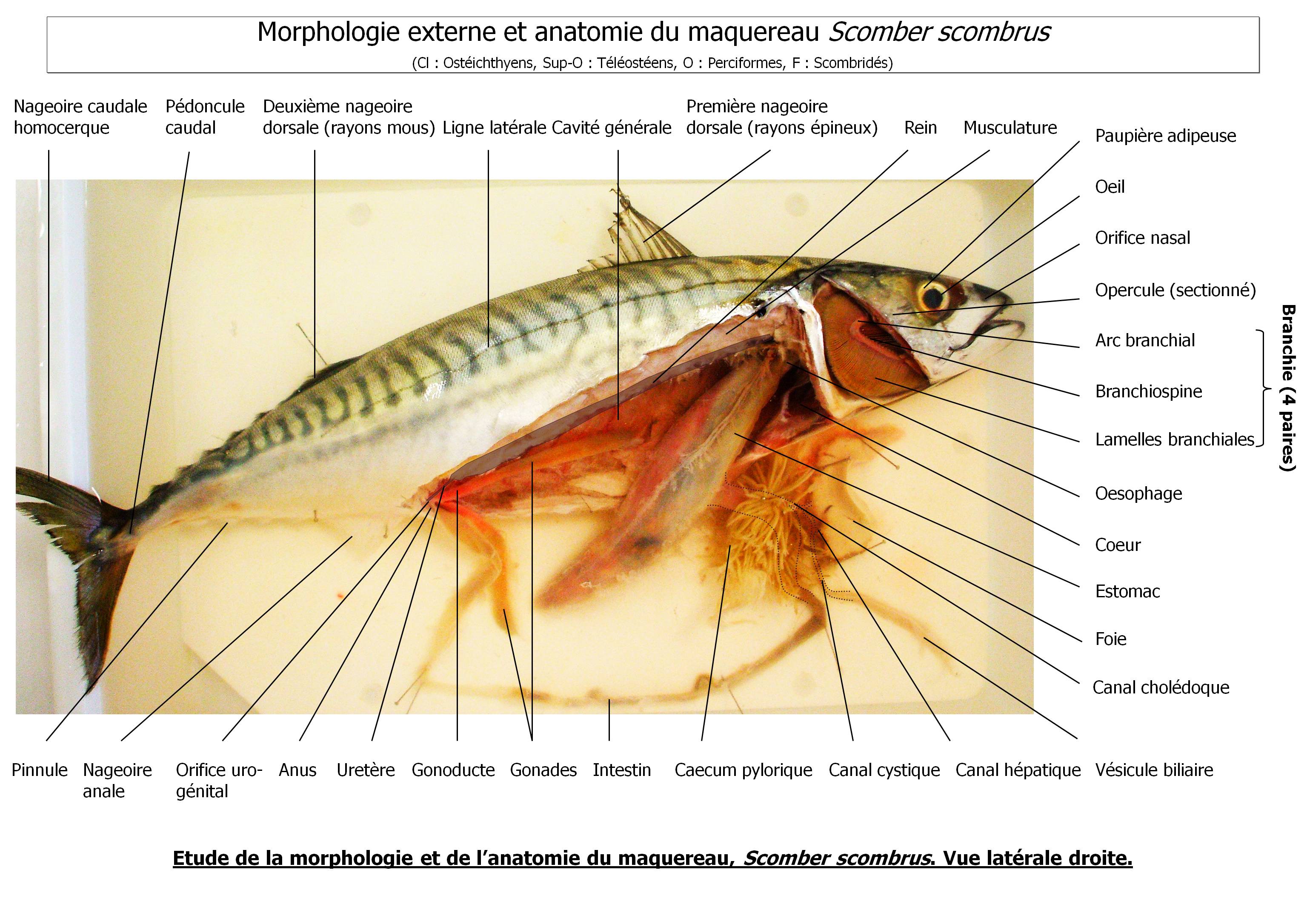
[ The dissection ended]
Sources:
- Wikipedia http://fr.wikipedia.org/wiki/Maquereau_commun
and http://fr.wikipedia .org / wiki / Anisakis - site DORIS: http://doris.ffessm.fr/
- For the lateral system: Animal Biology, Lescordés: Comparative anatomy of vertebrates. 9th edition. Andrew Beaumont, Pierre Cassier. Editions Dunod 653p.


0 comments:
Post a Comment