Wednesday, August 11, 2010

Roulette Minimum Bet 0.01

Why Cephalopods he throw the traditional classification?

We saw in the previous article some features of the classification method or modern cladistics. And if s classification change, much to damn all systematists veterans, there are multiple reasons why it should be presented before discard our old treaties (ie an image is made no thanks!).

The anthropocentrism and teleology
Older classifications using private groups such as "invertebrates", "jawless" etc.. Now these groups have Phylogenetic no value, they do not make connections, but just to highlight the absence of attributes present in other groups. And vertebrates lack the vertebrae that man has not agnathans jaw that man a. In this sense the traditional classification of the inherited defect of anthropocentrism and teleology of "the scale of being " Leibnitz (1646-1715) who saw in nature a linear order and a gradation of species of lichens, mosses, from fish to reptiles, Men in angels ...
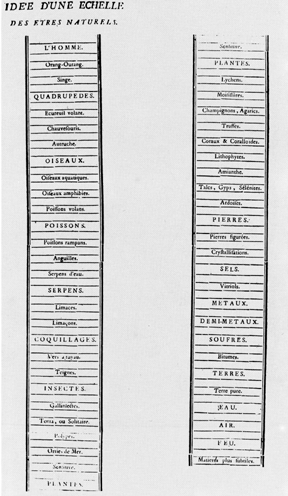
[The scale of beings or Scala Naturae: to follow in order: elements minerals, plants, animals, humans, and in some versions the angels ...]

Essentialism

Essentialism is the idea that essence precedes existence, ie that the species exists naturally and almost independently of individuals, and any intraspecific variation (within species) is erased and each species may represent a type specimen used for comparison: the holotype preserved in the museum. This idea culminates At the time of Linnaeus, who established the genus name and species and produces a classification of the most ambitious "Systema Naturae," or the male mallard is a different species of the female (What man field!). For a classification is natural, it should be possible without preconceptions.

Ecological and 'adaptive hopping' The first classifications
(Theophrastus, about -300 BC) are primarily utilities, such as plant has medicinal properties, such fish are eaten, etc.. By following the concepts of ecology have been added including the living environment, and despite numerous signs indicating the rapprochement between crocodiles and birds right from the nineteenth, the degree of reptiles has been retained under the pretext that the flight is birds jump adaptive enough to give him a class apart. Now the crocodiles are closer to birds than they are lizards or turtles.
[Classification traditional bubble gives a grade separated to birds because of ecological characteristics.]

Groups rendered obsolete by the usual method cladistiqu

Similarly, the group of fish has a legitimate existence of a culinary point of view is nothing but an evolutionary point of view (except for craniates without legs). It's the same for many other classical groups and known to the general public have no coherence of a phylogenetic perspective:
Here some in plants: algae, bryophytes (mosses), pteridophytes (ferns). And animals: invertebrates, fish, reptiles ...
[paraphyletic group of reptiles, and phylogenetic classification correct: lépidosauriens / archosaurs]

Ultimately the traditional classification is called eclectic everything about her legacy of old classifications and therefore their faults. And if the change is radical indeed it is still necessary because for the first time the classification is methodical transparent consistent with the principles of evolution.

[Home]

Tuesday, August 10, 2010

In Climbing What Does Vs Stand For?

phylogenetic classification summary.

animal biology was revolutionized during the past 30 years by applying the method of Classification Willi Hennig : the cladistic formalized in 1950, which proposes to create groups with a common ancestor and all its descendants. So that the Darwinian concept of descent with modification is for the first time completely and thoroughly exploited. But before returning to the principles of classification back on the approach of the classifier and the target of a relevant classification.

[phylogenetic tree of life proceeds from the cladistic method of Hennig, circular representation.]

Why classify?


To learn how to classify it should clearly define the reason for the classification. So if the record shop class musical genres is the purpose of enabling the amateur to easily find the music he loves. Classify this is not sorted (Separating a set into two groups for example rock / no rock spine / no spine). Sorting allows for determination keys, but not to make combinations, there are no fan of "non-rock '. Rate this order is not (because of stored items in a group as a continuous variable: for example in order of increasing size); imagine Fnac CD with all mixed in alphabetical order. NO, is realizing Sort groups of proximity between different elements. Indeed the interest of a classification is to make intelligible (understandable) diversity of a collection, whether cash or discs.
Willi Hennig (1913-1976)

How to classify?

To classify it must answer the question "who is closer to whom?" This close relationship of species (phylogeny ) is distinguished from relations of descent (genealogy). Indeed it is impossible to answer the question of who goes down, unless there is a civil registry of life dating from 3 Billion years hidden in an Amazon jungle ...

So we will classify the species according to characteristics they share, assuming that the closest species are those that share more common characteristics. Each evolutionary innovation makes it possible to group all species form a monophyletic group said that includes a hypothetical ancestor (the first to introduce this innovation) and all its descendants. In this way, it produces coherent groups in terms of evolution.


The phylogenetic classification

In summary for classifying a sample of species four steps needed: 1 - Identify characters counterparts. 2 - Polarizing the characters with an extra-group, ie determine which characters are ancestral and derived characters. 3 - Place on trees all evolutionary changes. 4-Select the most parsimonious tree, is to say the one with the fewest assumptions transformation.

[Example of tree construction phylogenetic:]
-matrix characters (1: indicates the derived state, 0 the primitive state of nature Trees
possible with this matrix, only the most parsimonious is retained

greater the number of significant cash plus the number of trees to be explored is large, and without this computer cladistic method is not feasible, so that Hennig has formalized the procedure from the 50 years it took another 30 to 40 years for that it is applied, and it will still take some years to see disappear completely the traditional classification called eclectic.

Article Wikipedia

[Home]

Sunday, August 8, 2010

Maggie Simpson Tattoo

Biology Animal science structural

After several weeks of well deserved break (well Jecrois), the time has come for me to get back to work, especially as masituation professional exchange, and yes through this blog I got a posteen animal biology and animal physiology at the UPPA (University of Pau and the Adour desPays) . This is an opportunity for me to update mesconnaissances biology animal and share it with you! C'estpourquoi future articles will be directed biology of organisms aussiconnu under the name of animal biology or zoology.

The biologieanimale: object of study and disciplines
As its name clearly indicates animal biology isthe discourse on the lives of animals, also known as metazoans Morethan for prestige. This science is therefore to describe accurately and rigueurl'ensemble the "animal" in all its diversity, to establish morphological and anatomical descomparaisons that will establish "body plans" kind of "layout type" of groupof animals, and any zoologist grail "for the former. "
[Organization plan of a mollusk type: cetorganisme imagination has all the attributes of molluscs, but did pasd'existence real]


To do zoology maintaining relationships étroitesavec many disciplines, including:
  • systematics (the science of classification) and lataxinomie (science of names).
  • ecology and evolutionary science studying the relationship with their disorganized environment (see article: a good way motécologie)
  • Paleontology, a kind of animal biology in the past who studies the evolution fossilesautant .
  • physiology that explains the inner workings of seprolonge agencies and molecular biology. And finally
  • developmental biology that describes and explains how organizations dedéveloppement cell egg to adulthood.
[Diagram: animal biology, a carrefourdisciplinaire and therefore a basic condition]

Structure versus Process
All these disciplines are related although leursproblématiques is totally different. But in general we peutdistinguer two main types of science: science that describe structural quel'on call, their question is "What?" AndTHE sciences that explain the process and the question is " How ". Ainsil'écologie and physiology are typically science processes, while the descriptive embryology and zoology are sciencesstructurelles. This division is of course an approximation but it permetd'éclairer changes observed in university teaching inthe past 50 years.

Indeed if the research effort turned to lessciences processes, the explanation exciting mechanisms restenéanmoins dependent information and structural descriptions produced by lessciences as animal biology and more recently lagénétique. The teaching of these sciences is therefore crucial effortde although research on these issues is less, they are a kind of soclecommun, an essential prerequisite. Thus the first cycles universitairescontiennent always bases disciplines lazoologie eras past queens and botany, but the old clutch these areas are active and fault plusaussi research in this field the university does peutproduire enough teachers in these parts, it is well obligerde appeal to my greatest happiness to the general dusecondaire teacher like me!

Wikipedia article: Zoology
[Home]