World Cup football had two merits: highlight the incompetence of the France team, and highlight the capabilities of a remarkable group: cephalopods, the most prominent representative "
Paul Octopus" presented near capacity parapsychic divination. Indeed Paul octopus predicted the team Winning matches for Germany with a remarkable success rate (almost 90%). Note in passing that the success rate on a draw is already 50%, Paul finally did just win a coin several times! For those interested in the procedure see the video at the bottom of the article. This performance deserves a thorough examination of these cephalopods with fascinating biology ...
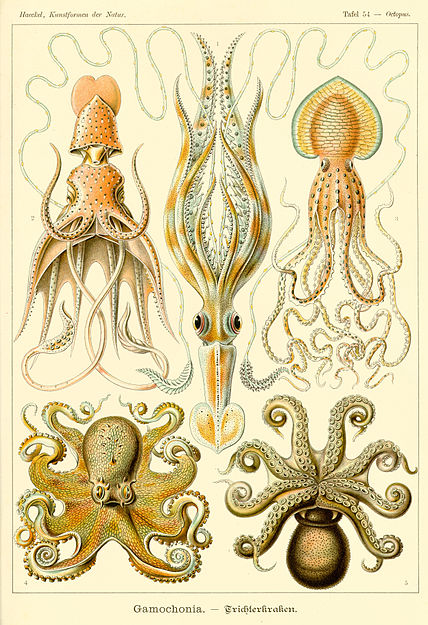
[ board of the famous biologist Ernst Haeckel on cephalopods ] foot in the head ... Cephalopods are mollusks whose foot muscular mass used for locomotion, migrates in front of the head, hence the group name: cephalopod "foot in the head." There are 730 species of cephalopods divided into two groups, tétrabranches (nautilus: ammonite fossils close to outer shell) and dibranched including decapods (10 tentacles: cuttlefish and squid) and octopodes (squid or octopus and the Argonauts). They are divided on all the seas of the world except the Black Sea and live at great depths. The largest specimen is never observed a giant squid (genus
Archtiteuthis ) over 20m including tentacles is the largest of all the "invertebrate"!
[A giant squid - "For Science" has dedicated his record for the month of August on these watches marine] anatomical structures converged with those of vertebrates. Cephalopods have a number of structures converged with those of vertebrate zoologists have told the finalists that these animals were "particularly advanced. "In effect the nervous system usually glandular here is extremely centralized and forms a" brain "enclosed in a cartilaginous capsule, equivalent to the cranium craniates. The open circulatory system among other molluscs is here and has a closed heart. Finally, the eye has a very strong convergence with the vertebrate one finds indeed the eyelids, cornea, iris, lens and retina, which is directly contrary to that of vertebrates that is reversed. (See chart for comparison)
[The eye in the vertebrate retina, inverted and direct eye retina of cephalopods]
Predators cunning. Cephalopods are predators that hunt on the lookout, they disguise themselves by taking the background color (cryptisme -
See article) with pigment cells: chromatophores. The tentacles capture prey and bring them to the mouth, which is equipped with "standard" of two skeletal jaws forming the "parrot" can break the shells Most of the prey. Finally when threatened, cephalopods emit ink, black pigment granules, secreted by the pouch of black. The ink always comes in the manufacture of ink, or sepia (the genus name of the cuttlefish Sepia).
[Cuttlefish emitting a cloud of ink through the funnel. Note also the right, cryptic color of the skin.]
also allows the central nervous system of cephalopods develop remarkable behavior in social life and hunting techniques. So if you put in the tank of an octopus (Paul or another) a crab trapped in a jar, he learns about thirty trials to remove the cap to capture its prey. Similarly more complex experiments showed impaired memory, learning and orientation of these molluscs. To say that Paul has a real talent there is just not ... that I will not cross!
A group of human interest. finish by noting that cephalopods are a group of interest man, both in the culinary field, where the fricassee of squid satisfied our stomachs, as in science, in which fossil ammonites are an invaluable stratigraphic and a witness of evolution.
[Video: Paul octopus at work in the crackling flashes.]