These are among the most memorable experience of teaching and often criticized or cited as a trauma, dissections are nonetheless a remarkable exercise Observing the many pedagogical virtues. In these four articles entitled "chronic dissection" I shall return to these farm animal biology L2 UPPA.
TP1: mouthparts and the anatomy of a cricket
Subject Study: Locusta migratoria
"They covered the surface of the earth and the earth was in darkness, and they ate every plant of the earth and all fruit trees, [...] and there remained any green trees or plants of the fields in all the land of Egypt. "
 The Bible, Book of Exodus 10, verse 16.
 The migratory locust, Locusta migratoria is an orthopteran insect species belonging to the category of locusts: that is to say, crickets and locusts (capable gregarious life, swarm). It is also the case of locusts or locust. When population density is relatively low, the Desert leads a solitary life and eat normal amounts. But under certain conditions, when population density increases, due to wind convergence, the distribution of plants, or the concentration of egg laying (80 to 100 eggs every two months), locusts form a swarm. Under the effect of serotonin, the morphology and behavior of desert then changed radically: the color is more vivid, making more food (each locust eats its own weight in vegetation every day !), And the behavior is gregarious swarms with exceeding several billion people.
Although the consequences are disastrous for crops, the swarm can travel up to 200km per day under the action of the winds. Gregarious locusts are not one of the 10 plagues of Egypt for nothing!

[The desert locusts in the gregarious phase and left in solitary right]
mouthparts: Warning scrapping!

The digestive tract.
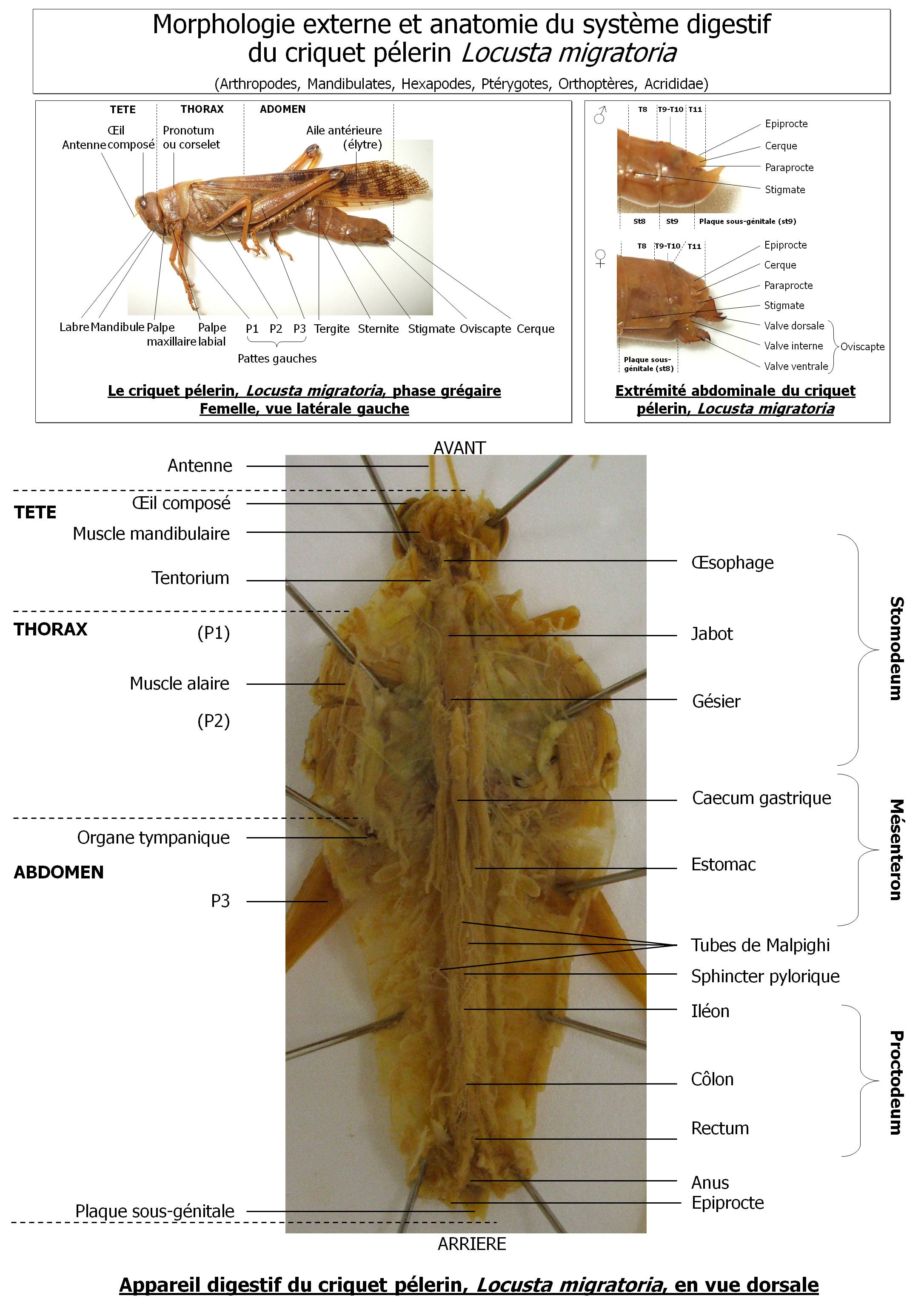
 In the strange language used to describe the gut of insects is more or less the same as that used for the digestive tract of vertebrates. (My students may, however, probably attest that the vocabulary of zoologists is not poor either!). We speak of "stomach, gizzard, etc. rectum. And that although the structures and functions is often very different.
 The gut is divided into three segments: stomodeum, the midgut, and proctodeum. The first segment consists of an esophagus, a crop and a gizzard's primary role is to grind and store ingested food. The boundary with the following segments is marked by swelling: the gastric caeca number 6 (sort of diverticula to increase the absorption surface), then comes the stomach that extends to the pyloric sphincter, insertion zone of the Malpighian tubes (responsible for the excretion of nitrogenous waste). Finally, the last segment includes ileum (intestine) short, a colon, rectum and inflated, leading to the anus.
Sources:
- Wikipedia http://fr.wikipedia.org/wiki/Locuste and
http://fr.wikipedia.org/wiki/Criquet_migrateur - site CIRAD Desert: http://locust.cirad.fr/tout_savoir/index.htm
- Lab Animal Biology - Zoology Embryology Histology, 3rd edition. Andrew Beaumont, Pierre Cassier. Editions Dunod 502p.
[Home]


0 comments:
Post a Comment