
Question surprising and exciting as you will be able to judge for yourself by few moments ... If you do not flee like the coward running scared by any user reading lines! But first start by defining the aging or "senescence", this is a decrease with age of the phenotypic ability : the famous "fitness" of Anglo-Saxon, to be clear is aged as soon as our survival and our ability to reproduce decreases (fast enough unfortunately). The problem is that the laws of evolution tell us that individuals who have the best phenotypic fitness (or fitness) are selected from this point of view may seem paradoxical Aging, Why Does evolution did she not selected individuals eternally young? Certainly not to please the sellers wrinkle creams ...
Survival hopes and generational change: Out!
The intuitive response that could emerge quickly is to say that although some must die to make room for young and so allow resources to younger individuals that contributes to the generational change and thus the diversity of the species and thus to "change>>. In this case, there may be genes in senescence, which directly cause the aging of the body. The problem with this hypothesis, it is sufficient that one individual does not possess the genes for aging it is automatically selected (by its better survival and better reproduction). Once again the concept of survival of the species is often admitted to being wrong. And yes, as in the case of lion infanticide selection occurs at the individual and not the group. The hypothesis of aging genes is eliminated.
accumulation of mutations and shade selection (Medawar 1952).
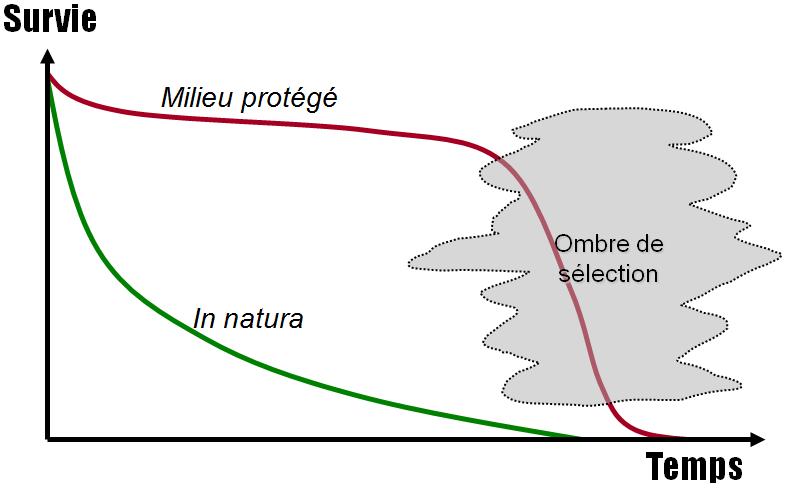 A simple observation can put us on the path of some logical explanations of evolutionary perspective: the aging occurs rarely in nature, this phenomenon is observed easily than men, and domestic animals which live in a protected environment. Indeed, survival in nature is limited by an environment-related mortality is often high (predation, food resources, climate), so the number of individuals surviving into old age is low. We can also assume that these individuals have already played several times and have transmitted their genes to their offspring. For all these reasons, natural selection is a filter much less effective at older ages, it is called "shadow selection. Indeed, if mutations have a deleterious effect at older ages occur, they will be forwarded until this is expressed. Some genetic diseases such as Huntington's chorea are good illustrations of this theory: the deadly disease only affects people between 40 and 50 years, and its importance in the population (3-7 cases per 100,000 people) is higher than the proportion else fatal genetic diseases but speaking of the same type at any age. Individuals carrying the mutation had indeed had plenty of time to reproduce and transmit the defective gene. In short when the selection does not work mutations accumulate, and finally "old" are merely the expression of genes misfire that escaped through the cracks speaking out on the latest ...
 Pleiotropy antagonistic: the good guys become the bad guys (Williams, 1957) .
Scientific theories are like the software, when they are incomplete, you develop plug-ins and other expansions ... Here it is the antagonistic pleiotropy, austere and difficult name to place in a conversation I agree. The idea is that some genes may have a very positive effect an early age where the selection pulls its weight, but return their jacket when it fades with time. Take an example: either a gene that regulates hormonal balance including testosterone. The expression of this gene allows the individual to have constant concentrations and elevated testosterone, which is indispensable for good reproduction, the gene is selected when the individual is young. But in the long term, high levels of testosterone have detrimental effects on physiological aging. Hence the term antagonistic pleiotropic gene effect (from the Greek pleio, more, and troponin, change) ... In this case, we age so to better survive the important moments.
A disposable body once his mission accomplished: the disposable soma (Kirkwood 1977) .
 Last idea among evolutionary theories of aging: the "disposable soma" ... We consider here that available resources are used by compromise. And so the energy available in the environment is limited, so it should be shared among several functions such as survival, reproduction, or maintenance of the body. Take the case of a mouse, naturally his life expectancy is 1 year and the leading cause of death was hypothermia All energy resources are preferably allocated firstly to reproduction (before winter), and secondly to thermogenesis. And yes, the anti-aging (repair, maintenance) are too costly in energy, but why invest resources in this area only to die of cold ... Otherwise known genes maintenance / repair are selected when the chances of survival are important.
 An evolutionary idea not to grow old .

One of the few proven ways to completely limit the aging involves making a caloric restriction. In other words, you have to eat balanced and shortcomings, but in very small quantities. Mice were able to extend the life of 30 to 60%! Another interesting figure, the inhabitants of the island of Okinawa in Japan practice caloric restriction (indeed the custom is that one leaves the table with the end in the belly), and although it is on this island found the largest number of centenarians per capita in the world (15% of centenarians in the world live on this island!). Now you know what you have to do to not grow old, we must simply do not live!
___________________ To learn more about the physiological causes of aging go to page research, or download the report bibliography: Aging: Perspectives ecological options.


0 comments:
Post a Comment